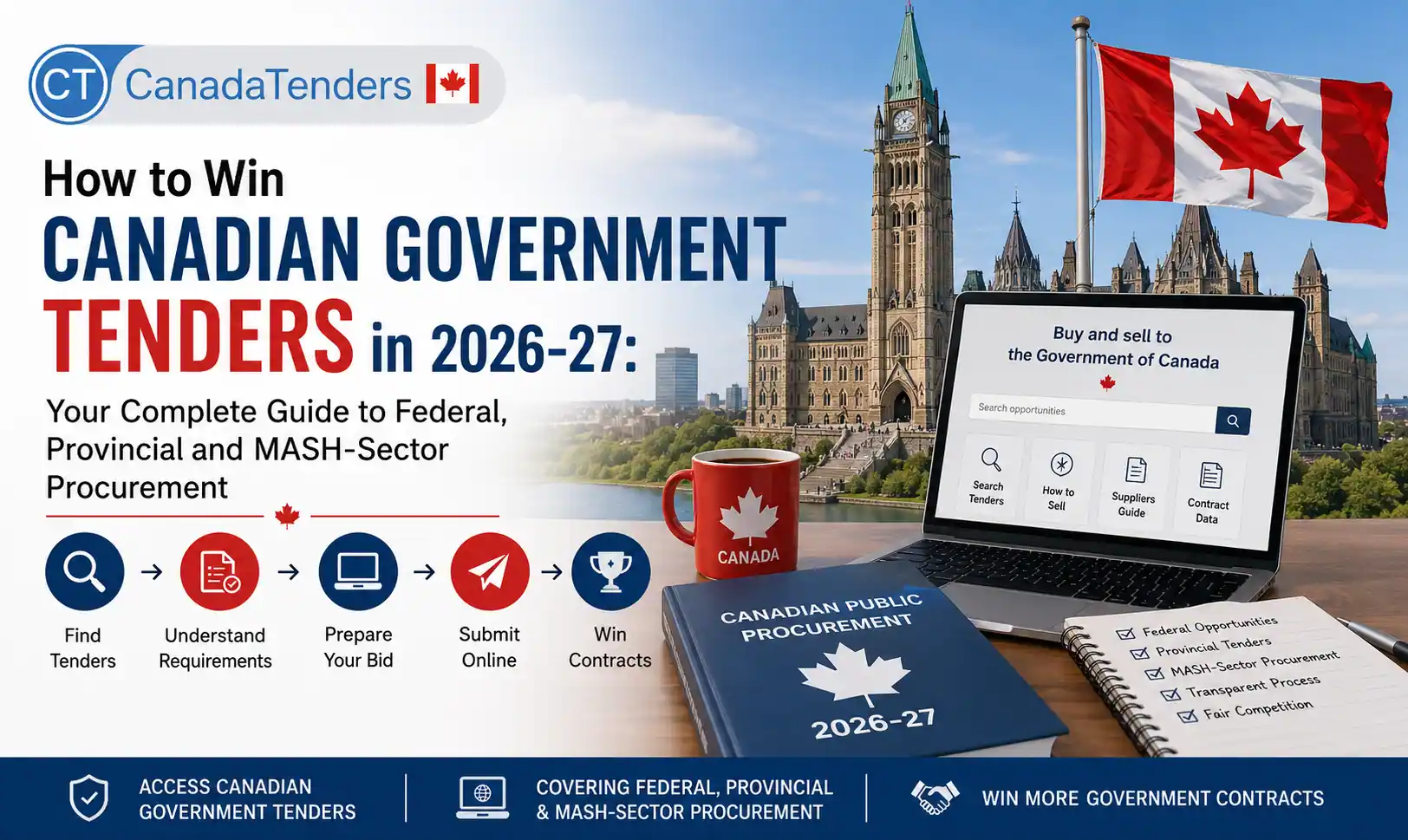
How to Win Canadian Government Tenders in 2026-27: Your Complete Guide to Federal, Provincial and MASH-Sector Procurement
Published on CanadaTenders.com | Category: Canadian Public Procurement | Reading time: 15 min
Every business day, federal departments, provincial ministries, municipalities, hospitals, school boards and Crown corporations across Canada publish government tenders, Requests for Proposals and procurement opportunities worth hundreds of millions of dollars. Most Canadian businesses, including many experienced contractors, never see the majority of them because they don't know which portal to monitor, how the new Buy Canadian policy reshapes evaluation scoring or what a genuinely competitive government bid needs to contain in 2026.
This guide gives you a practical, fully updated account of how Canadian public procurement works right now: the federal framework, current trade agreement thresholds, every portal you must monitor, the Buy Canadian Policy changes effective from December 2025, Indigenous procurement set asides, the step by step registration process and what to include in a winning bid. CanadaTenders.com monitors CanadaBuys, all provincial and territorial portals and the MASH sector, delivering matched opportunities directly to you so you never miss a contract that fits your business.
→ Search Live Canadian Government Tenders Now
The Canadian Public Procurement Market: Federal, Provincial and MASH
Canadian public procurement operates across three genuinely distinct layers and understanding all three is essential for building a sustainable contracting pipeline:
- Federal government: Led by Public Services and Procurement Canada (PSPC), managing over CAD $22 billion annually across more than 100 federal departments and agencies, from National Defence and Health Canada to the Canada Revenue Agency and Transport Canada. At any given time, 15,000–20,000 active federal tender notices are live on CanadaBuys, ranging from sub $25,000 professional services quotations to multi billion dollar shipbuilding and defence programmes.
- Provincial and territorial governments: Ten provinces and three territories each run their own independent procurement laws, portals and evaluation rules. A contract with the Ontario government is governed by entirely different rules than one with the government of British Columbia or the government of Quebec. Registration on one province's portal does not carry over to any other.
- MASH sector (Municipalities, Academic institutions, Schools and Hospitals): Collectively representing a further $15-18 billion in annual contract activity, this is often the most accessible entry point for smaller and newer Canadian businesses; contracts tend to be closer to home, smaller in value and less administratively intensive than federal strategic procurements.
Construction and infrastructure leads all Canadian procurement categories by total value, followed by professional services, architecture and engineering, IT and software and transportation and logistics. Small and medium businesses win the majority of contracts by count, the Canadian system is genuinely designed to give SMEs a real path to winning, not just a nominal one.
The Federal Procurement Framework: Rules That Govern Every Federal Bid
Federal procurement is governed by the Financial Administration Act and the Government Contracts Regulations, supplemented by the Treasury Board's Directive on the Management of Procurement. The guiding principle across all federal guidance is that procurement must be conducted in an open, fair and transparent manner, every eligible supplier must have a genuine, equal opportunity to compete and contracting officers must achieve best value for Canadian taxpayers.
Canada's procurement obligations are shaped by multiple trade agreements that determine when a contract must be openly competed and which suppliers may participate:
- Canadian Free Trade Agreement (CFTA): Canada's internal trade agreement ensuring suppliers anywhere in Canada can compete for covered contracts regardless of province or territory of registration.
- WTO Agreement on Government Procurement (WTO GPA): Opens covered Canadian procurement to suppliers from GPA signatory countries. Importantly, CUSMA (the Canada US Mexico Agreement) does not contain a government procurement chapter applicable to Canada, it is the WTO GPA, not CUSMA, that governs Canada US federal procurement access.
- Canada EU Comprehensive Economic and Trade Agreement (CETA): Opens federal and in many cases, provincial and municipal procurement to EU suppliers.
- CPTPP (Comprehensive and Progressive Agreement for Trans Pacific Partnership): Covers procurement access with ten Asia Pacific economies including Japan, Australia and Mexico.
- Bilateral free trade agreements: Including Canada Korea (with the lowest international threshold of any agreement at $100,000 for goods and services), Canada UK, Canada Chile and others, each with its own procurement chapter.
Canada Federal Procurement Thresholds 2026-2027
Trade agreement thresholds are revised every two years. The following figures, published by Treasury Board in Contracting Policy Notice 2025 8, apply from 1 January 2026 through 31 December 2027. Most thresholds fell from the 2024–2025 period, meaning more contracts now fall under mandatory open competition rules:
- CFTA (internal, federal departments and agencies): Goods: $34,700 | Services: $139,000 | Construction: $139,000
- WTO GPA, CETA and CPTPP (federal departments and agencies): Goods and services: $239,200 | Construction: $9,200,000
- Canada Korea FTA: Goods and services: $100,000 (lower than WTO GPA, requires separate compliance for procurements between $100,000 and $239,200)
Below thresholds, contracting officers have more discretion to apply Canadian or regional preferences. Requirements above $25,000 for goods or $40,000 for services and construction are still published on CanadaBuys as a federal transparency obligation, even where trade agreement coverage doesn't technically require it. Below $25,000 is treated as low dollar value procurement, quotations can be solicited directly.
The Buy Canadian Policy: What It Means for Your Next Bid
Effective 16 December 2025, the federal government implemented the most significant shift in Canadian procurement policy in over a decade. For Canadian suppliers, this is genuinely good news, if you understand how to use it. For international suppliers, it changes the competitive calculus in specific sectors and above specific values.
- Policy on Prioritizing Canadian Suppliers and Canadian Content: Applies to strategic federal procurements currently above $25 million (expanding to above $5 million from 15 June 2026) in defence and security, health and pharmaceutical, infrastructure, construction and transportation, IT and ICT and consumer and industrial goods. Where it applies, a qualifying Canadian supplier receives a 10% fictitious reduction applied to their bid price for evaluation scoring (your actual contract price is unchanged). A further 25% of the evaluation score is tied to your committed Canadian value added content. If you are a Canadian company in these sectors and are not clearly documenting your Canadian content in your proposals, you are leaving real evaluation points on the table.
- Policy on Prioritizing Canadian Materials: For federal construction and defence projects valued at $25 million or more with a material requirement of at least $250,000, Canadian produced steel, aluminium and wood products must be used where a Canadian source exists. The material must be genuinely manufactured or processed in Canada; a resold imported product does not qualify.
- Interim Policy on Reciprocal Procurement: In force since 14 July 2025 and fully implemented by spring 2026. Limits non defence federal procurement access to suppliers from countries that provide reciprocal access to Canadian suppliers. Confirm your trading partner status if you are partnering with or subcontracting from international suppliers.
- Small and Medium Business Procurement Program: A new $79.9 million initiative expected to launch in spring 2026, designed to reserve federal procurement opportunities specifically for Canadian SMEs. If you qualify as an SME, this programme will create protected channels that larger competitors cannot access. Watch CanadaBuys and PSPC announcements closely as implementation details are finalised.
Official Canadian Tender Portals: The Complete Map
No single portal covers all Canadian public procurement. Comprehensive coverage requires monitoring multiple systems across federal and provincial layers:
- CanadaBuys (canadabuys.canada.ca), the official federal e-procurement platform, publishing RFPs, RFSOs, supply arrangements, ACANs and RFIs from all federal departments and agencies. PSPC launched a new Buyer's Portal on 30 January 2026, replacing the PSPC Supply Manual as the official guidance source for federal acquisitions.
- BC Bid, British Columbia's central procurement portal, covering BC Hydro, BC Transit and ICBC alongside provincial ministries.
- Alberta Purchasing Connection (APC), Alberta's central provincial procurement portal.
- SaskTenders, Saskatchewan's provincial government procurement portal.
- Ontario Tenders Portal / Supply Ontario, Ontario's provincial system, alongside significant use of MERX and Bids & Tenders for MASH sector content.
- SEAO (Système électronique d'appel d'offres), Quebec's central procurement portal covering provincial ministries, public agencies, the health network, the education network and all Quebec municipalities. Primarily in French.
- MERX, Canada's longest running commercial tendering platform (launched 1997), aggregating provincial and MASH sector notices from all ten provinces and three territories. Full document access typically requires a paid subscription.
- Atlantic Canada portals, NBON (New Brunswick), NS Tenders (Nova Scotia), PEI Tenders and the Newfoundland and Labrador Public Procurement Agency.
- Territorial portals, the Yukon, the Northwest Territories and Nunavut each maintain their own systems.
- MASH sector platforms, Bids&Tenders, Biddingo and Bonfire are the dominant commercial platforms for municipal, school, university and hospital procurement. Major city portals (Toronto, Vancouver, Calgary, Montreal) also publish directly.
CanadaTenders.com consolidates notices from CanadaBuys, all provincial and territorial portals and the major MASH sector platforms into one searchable, alert driven feed, so you receive every relevant opportunity matched to your sector and region without logging into a dozen separate systems daily.
Step by Step: How to Register for Federal Canadian Tenders
- Step 1, Get a CRA business number: Required to finalise any federal contract you win. Register with the Canada Revenue Agency if you don't already have one.
- Step 2, Register in Supplier Registration Information (SRI): The federal directory of suppliers interested in doing business with the government. SRI registration gives you a Procurement Business Number (PBN), required to bid on opportunities not posted through SAP Ariba. Processing typically takes 2–3 business days.
- Step 3, Register in SAP Ariba: PSPC now manages many of its own solicitations through SAP Ariba; separate registration here is required to bid on PSPC managed opportunities directly.
- Step 4, Identify your GSIN and commodity codes: Federal procurement uses Goods and Services Identification Numbers (GSIN) to classify products and services. Selecting the correct codes ensures your company appears in buyer searches and that you receive relevant opportunity notifications.
- Step 5, Register on provincial portals separately: CanadaBuys registration carries over to nothing at the provincial level. BC Bid, APC, SEAO, SaskTenders and every other provincial portal each require independent registration, plan these as separate tasks before targeting provincial work.
- Step 6, Set up targeted alerts: Configure keyword, commodity code and buyer specific notifications on CanadaBuys and your relevant provincial portals. Or use CanadaTenders.com's consolidated alert service to receive matched opportunities across all Canadian portals in one daily notification.
- Step 7, Explore simplified tools for sub $100,000 work: PSPC maintains ProServices (IT, business, HR and technical services) and SELECT (architectural, engineering and construction services) as simplified sourcing tools for lower value professional services contracts, accessible once your SRI registration is active, with lighter process requirements than a full competitive tender.
Federal Procurement Document Types: What You Will Encounter
- Invitation to Tender (ITT): Sealed bidding, awarded on price as the primary factor for well defined, standardised requirements.
- Request for Proposal (RFP): Complex requirements where technical approach and quality are weighted alongside price. The most common vehicle for professional and consulting services.
- Request for Standing Offer (RFSO): Pre arranged pricing and terms, successful suppliers are on call to fulfil requirements as they arise, without a new competition for each call up.
- Request for Supply Arrangement (RFSA): Establishes a pool of prequalified suppliers who then compete in mini competitions for specific task based work throughout the arrangement's term.
- Advance Contract Award Notice (ACAN): Public notice of intent to sole source a contract to a named supplier. Other suppliers have a defined window to demonstrate they could also meet the requirement, if a valid statement of capabilities is received, a competitive process must follow.
Indigenous Procurement: The PSIB and the 5% Target
The Procurement Strategy for Indigenous Business (PSIB), in operation since 1996, reserves certain federal contracts exclusively for Indigenous businesses through set asides that are exempt from standard trade agreement obligations. Since 2022, federal departments have been required to meet a mandatory minimum target of 5% of total annual contract value awarded to Indigenous businesses. In 2023–24, over $1.24 billion was awarded to Indigenous businesses, approximately 6.1% of eligible spending, exceeding the target.
To participate in PSIB set asides, a business must be at least 51% owned and controlled by Indigenous persons and verified through registration on the Indigenous Business Directory (IBD) maintained by Indigenous Services Canada or through a recognised modern treaty business list.
A March 2026 review by the Office of the Procurement Ombud identified significant inconsistencies in how departments apply PSIB rules and noted that Indigenous suppliers currently cannot bring complaints about PSIB awards to either the CITT or the OPO, leaving the Federal Court as their only formal recourse option. Indigenous Services Canada has accepted recommendations to address this, with a transformed Indigenous procurement policy expected by winter 2026 and a dedicated Indigenous led recourse mechanism targeted for April 2028. If your business is Indigenous owned and participating in set aside competitions, this reform timeline is worth monitoring closely.
Major Federal Contracting Authorities: Know Your Buyers
Understanding which federal departments and agencies are the most active buyers in your sector is one of the most valuable pieces of business development intelligence available. CanadaTenders.com's contracting authorities directory lets you search, monitor and filter active buyers across the federal system, tracking which departments are publishing in your category, at what values and at what frequency.
The most significant federal buyers by procurement volume include Public Services and Procurement Canada (PSPC) acting as the central purchasing authority, the Department of National Defence (DND), Health Canada and the Public Health Agency of Canada, Public Works and Government Services, the Canada Border Services Agency, Transport Canada, the Royal Canadian Mounted Police, Environment and Climate Change Canada and Indigenous Services Canada. Provincial purchasing authorities, hospital networks, universities and municipalities each have their own buyer directories accessible through their respective portals.
Contract Award Intelligence: The Competitive Advantage Most Bidders Ignore
Knowing who won the last federal contract in your category and at what price, is the single most powerful pricing and competitive positioning tool available to Canadian government contractors. Every ACAN, every ITT award and every RFP contract award is published publicly on CanadaBuys. Over time, this data reveals: which buyers in your sector are actively purchasing, at what cadence, at what values and which incumbents are consistently winning.
CanadaTenders.com tracks Canadian contract awards alongside live tender notices, giving you the competitive intelligence to price realistically, identify gaps in incumbent relationships and position your bid narratively against what evaluators have previously rewarded. Most Canadian businesses bid reactively. Contract award analysis is how the consistently winning businesses bid strategically.
Bid Protests and Recourse: CITT and the Procurement Ombud
- Canadian International Trade Tribunal (CITT): Jurisdiction over designated contracts covered by a trade agreement, at or above the CFTA threshold ($34,700 for goods, $139,000 for services under the 2026–2027 figures). You must first object to the contracting institution, then file with the Tribunal within 10 working days of being notified your objection was denied. Remedies include bid re evaluation, a new solicitation, contract termination or compensation including bid preparation costs.
- Office of the Procurement Ombud (OPO): Reviews complaints about awards below CFTA thresholds and contract administration complaints at any value. Generally 30 working days from award notice to file. OPO also offers free, confidential Alternative Dispute Resolution for contractual disputes.
- Federal Court: Available for escalation beyond CITT or OPO and currently the only formal recourse for Indigenous businesses challenging PSIB award decisions.
Always request a debrief from the contracting officer after an unsuccessful bid, it is available under the Directive on the Management of Procurement and is your most accurate source of information on how your bid actually scored before deciding whether to challenge the outcome.
High Opportunity Sectors in 2026-27
- Construction and infrastructure: The highest volume category nationally, including federal buildings, provincial infrastructure, municipal roads, water systems and public buildings. Backed by ongoing capital investment at all three levels of government.
- Defence and shipbuilding: The National Shipbuilding Strategy, Canadian Armed Forces land vehicles and aerospace programmes and growing domestic defence spending are generating a sustained, multi year federal procurement pipeline.
- IT and professional services: Consistently high volume across the federal government, sourced through ProServices, Supply Arrangements and the Centralised Professional Services System.
- Healthcare: Hospital modernisation, digital health and medical equipment procurement, particularly active at the provincial level through dedicated group purchasing organisations including HealthPRO and Mohawk Medbuy.
- Transportation and logistics: A high volume, recurring category across federal, provincial and municipal buyers, including fleet management, transit infrastructure and logistics services.
Your Canadian Government Tender Bid Checklist
Before submitting any Canadian government bid, confirm each of the following:
- SRI registration is active and your PBN is current, check expiry dates before each submission.
- SAP Ariba registration is complete if the solicitation is managed through that platform.
- The correct provincial portal registration is active if bidding on provincial or MASH sector work.
- Your GSIN and commodity codes correctly reflect the services or goods in this specific tender.
- Your technical response addresses every mandatory evaluation criterion explicitly, not just the general scope, with the buyer's own language reflected back.
- If eligible for Buy Canadian Policy scoring credits, Canadian content is clearly quantified, documented and substantiated in your proposal, do not leave this to inference.
- If this is an PSIB covered procurement, your IBD registration status is current and your 51% Indigenous ownership and control documentation is complete.
- Submission deadline, date, time and time zone, is confirmed in your calendar, with a 24 hour pre submission review scheduled.
- You have identified the name of the contracting officer to request a debrief from, regardless of outcome.
Common Mistakes to Avoid
- Assuming CanadaBuys registration covers provincial work: It doesn't. BC Bid, SEAO, APC and every provincial portal each require independent registration, treat them as separate onboarding tasks.
- Using outdated threshold figures: Thresholds changed on 1 January 2026. Basing procedure choice or eligibility assessment on 2024–2025 figures is a common and avoidable compliance error.
- Not documenting Canadian content clearly: If you qualify for Buy Canadian scoring credits and don't quantify your Canadian content explicitly in the proposal, the evaluator cannot apply the credit, you score as if you had made no claim at all.
- Treating PSIB registration as a formality: Indigenous business status requires documented evidence of genuine 51% ownership and control. Arrangements that exist on paper without substantive Indigenous governance are increasingly scrutinised.
- Missing CITT complaint deadlines: Ten working days from a denied objection is a very short window. If you believe a federal award decision was improper, act immediately, CITT jurisdiction cannot be preserved after the deadline expires.
- Ignoring Quebec's language requirements: Provincial tenders in Quebec are published and managed primarily in French through SEAO. Bid documents, correspondence and proposals are expected in French. Plan language resources before targeting Quebec procurement.
Frequently Asked Questions
Q1: What is CanadaBuys and is registration mandatory for federal contracts?
CanadaBuys (canadabuys.canada.ca) is the official federal e procurement platform operated by Public Services and Procurement Canada (PSPC). It replaced the legacy BuyAndSell.gc.ca system and is the central source for all federal tender opportunities including RFPs, ITTs, RFSOs, Supply Arrangements and ACANs. Registration in the Supplier Registration Information (SRI) system to obtain a Procurement Business Number (PBN) is required to bid on most federal opportunities. For PSPC managed solicitations specifically, separate SAP Ariba registration is also required.
Q2: What are the current federal procurement thresholds for 2026–2027?
Published via Treasury Board Contracting Policy Notice 2025 8, effective 1 January 2026: CFTA thresholds are $34,700 for goods and $139,000 for services and construction. International thresholds under WTO GPA, CETA and CPTPP are $239,200 for goods and services and $9,200,000 for construction. Canada Korea FTA sets a lower $100,000 threshold for goods and services. Most thresholds fell from the 2024–2025 figures.
Q3: What is the Buy Canadian Policy and how does it affect my bid score?
The Buy Canadian Policy, in force since 16 December 2025, applies to strategic federal procurements currently above $25 million (expanding to above $5 million from 15 June 2026) in defence, health, infrastructure, IT and industrial goods. Where it applies, a qualifying Canadian supplier receives a 10% reduction to their bid price for evaluation scoring purposes only (their actual contract price is unaffected) and a further 25% of the evaluation score is tied to committed Canadian value added content. If you are a Canadian supplier in these sectors and are not clearly quantifying your Canadian content in proposals, you are forfeiting real evaluation points to competitors who do.
Q4: What is the PSIB and who qualifies for Indigenous set aside contracts?
The Procurement Strategy for Indigenous Business (PSIB) reserves certain federal contracts exclusively for Indigenous businesses. Federal departments must now award at least 5% of annual contract value to Indigenous businesses. To participate in set asides, a business must be at least 51% owned and controlled by Indigenous persons and registered on the Indigenous Business Directory (IBD) maintained by Indigenous Services Canada. A reformed PSIB policy with a dedicated Indigenous led recourse mechanism is expected to be fully implemented by April 2028.
Q5: Do I need separate registrations for federal and provincial procurement?
Yes, without exception. Federal registration (SRI/PBN and SAP Ariba) gives you access only to federal opportunities on CanadaBuys. Provincial portals, BC Bid, Alberta Purchasing Connection, SaskTenders, Ontario Tenders Portal, SEAO (Quebec) and all Atlantic and territorial portals, each require independent registration. There is no cross recognition between systems. Treat each provincial portal as a separate onboarding task for each new province you target.
Q6: What is the difference between an RFSO and an RFSA?
A Request for Standing Offer (RFSO) establishes pre agreed pricing and terms with one or more suppliers; call ups against the standing offer can then be placed as needs arise without a new competition. A Request for Supply Arrangement (RFSA) establishes a pool of pre qualified suppliers, who then compete in mini competitions for specific task requirements throughout the arrangement's term. Both are common vehicles for recurring professional services needs, winning a standing offer or supply arrangement can generate multiple contract call ups over several years from a single initial competition.
Q7: How do I challenge a federal procurement award I believe was unfair?
For contracts at or above the CFTA threshold, file an objection with the contracting institution first, then, if denied, file a complaint with the Canadian International Trade Tribunal (CITT) within 10 working days of being notified your objection was denied. For contracts below the CFTA threshold or for contract administration disputes at any value, the Office of the Procurement Ombud (OPO) can review your complaint, typically within 30 working days of the award notice. Always request a debrief first, understanding exactly how your bid scored often clarifies whether a formal challenge is warranted.
Q8: What is an ACAN and can I still compete when one is published?
An Advance Contract Award Notice (ACAN) is a public notice stating the federal government's intent to award a contract to a named supplier without running a competitive process. Other suppliers have a defined window (typically 15 calendar days) to submit a statement of capabilities demonstrating they could also meet the requirement. If a valid statement is received, the government must conduct a competitive process rather than proceeding with the sole source award. Monitoring ACANs in your sector is worth the effort, they are one of the clearest market intelligence signals of upcoming demand from specific buyers.
How CanadaTenders.com Helps You Win Canadian Government Contracts
CanadaTenders.com is built specifically for Canadian businesses targeting public sector contracts, from the federal government through to provinces, territories and the MASH sector. The platform consolidates tender notices from CanadaBuys, all provincial and territorial portals and major MASH sector platforms into a single searchable, alert driven feed:
- Real time tender alerts: Keyword, sector, authority and region based notifications matched to your business profile, delivered the moment a relevant opportunity is published, across every level of Canadian government.
- Contract award tracking: Monitor who is winning in your category, at what values and on what frequency, the competitive intelligence that separates reactive bidders from strategic ones. Visit CanadaTenders.com/contract awards to start tracking.
- Contracting authority monitoring: Track your key buyers' procurement activity directly through the authority directory, see what each department is buying, how often and at what scale.
- MASH sector coverage: Municipal, hospital, university and school board opportunities often inaccessible through a single portal are consolidated and delivered alongside federal and provincial notices.
- Indigenous procurement tracking: PSIB set aside notices and ACAN publications in Indigenous priority categories, flagged and delivered to qualifying businesses.
Need Help With Canadian Procurement?
Whether you are setting up your first SRI registration, navigating the Buy Canadian Policy's content documentation requirements or assessing whether a CITT complaint is worth pursuing after an unsuccessful bid, the CanadaTenders.com team can help. Contact us with your specific question.
Tags: Canada Tenders, Government Contracts Canada, CanadaBuys, PSPC Tenders, Buy Canadian Policy 2026, Indigenous Procurement Canada, PSIB Set Aside, CITT Bid Challenge, MERX, BC Bid, SEAO Quebec, Alberta Purchasing Connection, Canadian Procurement Thresholds 2026, Federal RFP Canada
CanadaTenders.com, Canada's dedicated public procurement intelligence platform. Covering CanadaBuys, all provincial and territorial portals, Indigenous set asides and the full MASH sector in real time.
→ Browse All Live Canada Tenders | → Register Free | → Subscribe for Premium Access

Fresh and verified Tenders from Canada. Find, search and filter Tenders/Call for bids/RFIs/RFPs/RFQs/Auctions published by the government, public sector undertakings (PSUs) and private entities.
- 1,000+ Tenders
- Verified Tenders Only
- New Tenders Every Day
- Tenders Result Data
- Archive & Historical Tenders Access
- Consultants for RFI/RFP/RFQ
- Tender Notifications & Alerts
- Search, Sort, and Filter Tenders
- Bidding Assistance & Consulting
- Customer Support
- Publish your Tenders
- Export data to Excel
- API for Tender Data
- Tender Documents

Fill out the form below and you will receive a call from us within 24 hours.
Get FREE SAMPLE TENDERS from Canada in your email inbox.
Copyright © 2014-2026 CanadaTenders.com. All Rights Reserved.